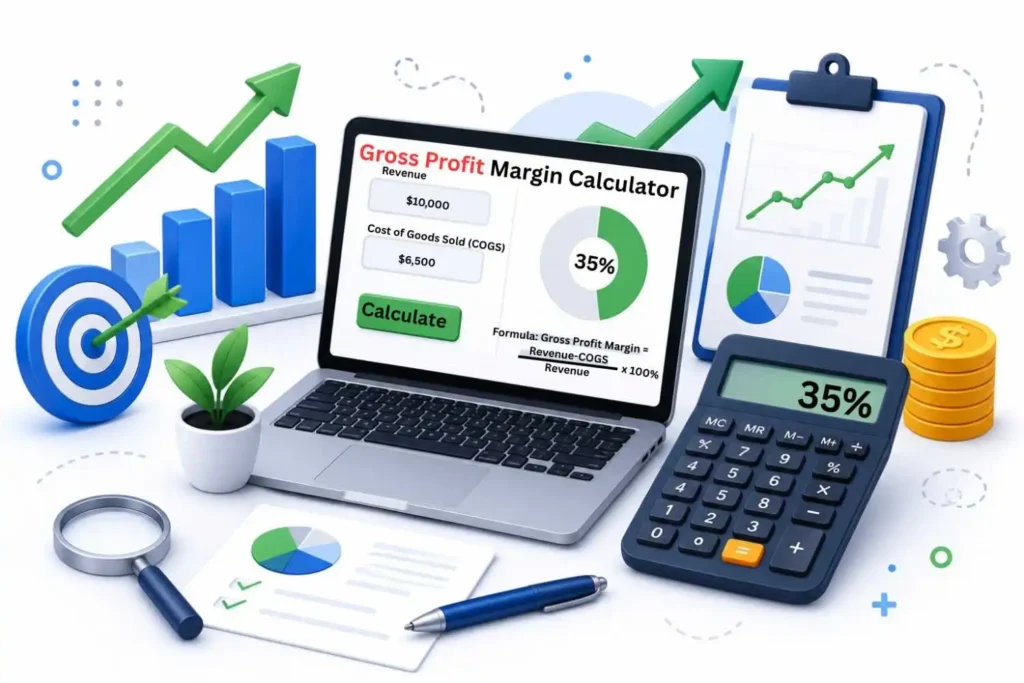
Pricing is one of the key components of running a successful business. Various entrepreneurs tend to mix up the various pricing techniques and this would result in inaccurate estimation of profits and unsuccessful decisions in finance. Markup and profit margin are two concepts that are commonly used in business pricing. The two assist in pricing products, albeit they are computed differently, and provide differing information on profitability.
We will explicitly describe the working of these two concepts in this blog and how they influence business decisions. This confusion can be simplified with the help of the markup vs. profit margin calculator comparison that can give the business a more clear picture of pricing strategies and help them become more accurate and have improved financial outcomes. Let’s dive in!
What is Markup?
The markup is the difference between the cost price of a product and its selling price. It is usually expressed as a percentage of the cost price. Markup enables businesses to make sure that they meet all their costs and make a profit as a result of every sale. An illustration of this is when a product is selling at a price of $100 with a 20% markup, the selling price is $120.
Markup is widely applied in retail and wholesale companies to determine price expeditiously. It assists companies in making sure that they are profitable but have a steady pricing policy on their products.
What is Profit Margin?
Profit margin: The profit margin is a percentage of the profit made by a business based on the total revenue before all expenses. It indicates the amount of profit that is realized on each sale. Profit margin is the selling price as opposed to markup, which is the cost price. In the case of a product selling at a price of $120 and making a profit of $20, then the profit margin is 16.67%.
It assists in making businesses know their actual financial performance and efficiency. The profit margin is highly employed in the analysis of profitability and informed decision-making on pricing, budget, and investment.
Markup vs Profit Margin: Key Differences
One of the most important things to understand to price correctly and make better financial decisions in business is the distinction between markup and profit margin. Both are concepts that are connected to the calculation of profits but will be applied differently and will depend on pricing strategy and business requirements.
| Basis | Markup | Profit Margin |
| Definition | Added percentage on cost price | Profit percentage on selling price |
| Base Used | Cost Price | Revenue (Selling Price) |
| Formula | (Selling Price − Cost Price) ÷ Cost × 100 | (Net Profit ÷ Revenue) × 100 |
| Focus | Setting selling price | Measuring profitability |
| Usage | Pricing products quickly | Analyzing business performance |
| Perspective | Cost-based approach | Revenue-based approach |
Markup is primarily applied to determine how a product will be sold, whereas profit margin is applied to determine the extent of the real level of profit an organization makes based on its sales. The two are significant but they have various uses in business pricing strategy and financial analysis.
Why Understanding Both is Important for Pricing
Markup and profit margin are important in understanding what correct and profitable prices are in a business. These two ideas give us two different ways in which pricing influences the total earnings. Markup assists businesses in determining the selling price in relation to the cost, whereas profit margin illustrates the actual profit made out of sales.
Taken collectively, they provide a whole picture of pricing policy and financial results. This allows business owners to avoid pricing their goods either lower than the market or higher, which enhances higher profitability, better financial planning, and stability of the business over time in a competitive market.
How Businesses Use Markup and Profit Margin in Pricing Decisions
Companies combine the two terms to develop effective and lucrative pricing strategies. They initially compute the markup to offer an appropriate selling price depending on the cost of the product to ensure that all the expenses are met. They then deconstruct profit margin to grasp the profit gained on each sale. The Profit Margin Calculator makes this process easier because it is able to display the correct results at a glance and the results can be easily compared by the business owners.
This assists in competitive pricing, enhancing profitability, as well as informed financial decisions. It also guarantees improved cost management, correct planning, and long-term business expansion in a competitive business environment.
Common Mistakes Businesses Make While Calculating
Proper pricing and profit analysis are critical to the success of a business, yet most businesses commit trivial calculation mistakes that result in wrong business decisions. Without appropriate identification and correction, these errors may impact the profitability, pricing strategy, and the overall business development.
- Mixing up markup and profit margin.
- Disregard of concealed or indirect expenses.
- Application of wrong values of revenue or cost.
- Not including all business expenses
- Errors in making calculations manually.
- Making assumptions rather than basing them on data.
- Misinterpreting percentage results
A profit margin calculator would reduce such errors by bringing about precise and trustworthy calculations to make improved financial decisions. It is a guarantee that businesses receive clear and precise results without getting confused. These pitfalls are easy to avoid, which guarantees a more accurate financial analysis and better decision-making. It assists corporations to better their pricing strategies, profitability, long-term financial viability, and sustainable growth in a competitive market environment.
Conclusion
In conclusion, markup and profit margin are two terms that require businesspeople to be able to distinguish between the two when making the right price determination in business. The two concepts assist business in pricing and in analyzing profitability, although they have different uses in financial planning. The correct way brings more precision and a much less likely chance of costly pricing strategy errors.
A proper interpretation of these calculations will result in smarter business choices, better management of profits, and financial stability in the long run. The Profit Margin Calculator simplifies this process, as it is a fast and precise way to save time and minimize mistakes that the business owner can make. All in all, the concepts are vital in mastering profitability, competitive pricing, and attaining sustainable business growth in the current competitive business world.
FAQs
Q1. What is the difference between markup and profit margin?
Markup is calculated on the basis of cost price and the profit margin is calculated based on the selling price. They are both applied to compute profit, albeit differently.
Q2. What is the purpose of markup by businesses?
Markup enables businesses to establish selling prices by adding a certain percentage to the product cost to guarantee profit.
Q3. Why is profit margin important?
Profit margin indicates the actual profitability of the sales and businesses can know how well they can make profits and how efficiently they operate.
Q4. Can a profit margin calculator aid in pricing choices?
Yes, the profit margin calculator gives fast and precise results, has fewer manual errors, and assists in preparing the prices and financial plans.
Q5. Markup or profit margin: which one is more important?
Both are important. Markup aids in price determination and profit margin aids in the analysis of actual profitability.